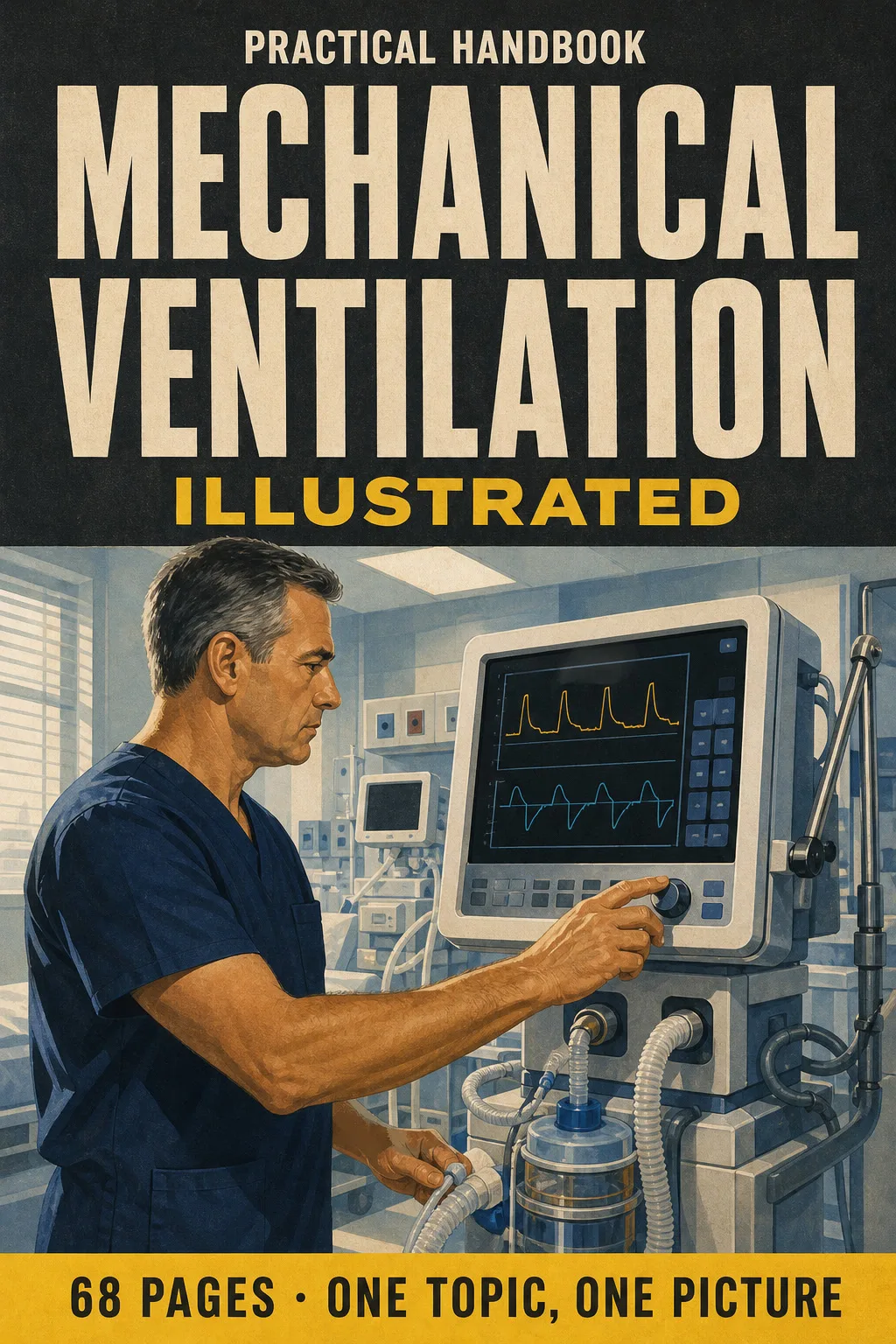
📄 Digital book in PDF · read it on your phone or print it
Tidal volume, PEEP, FiO2, A/C, SIMV, pressure support, waveforms, peak vs. plateau, alarms and ABGs. Every topic gets its own page: first the drawing, then what you need to remember. 68 illustrated pages.
🔒 Secure checkout · PDF by email · 30-day guarantee
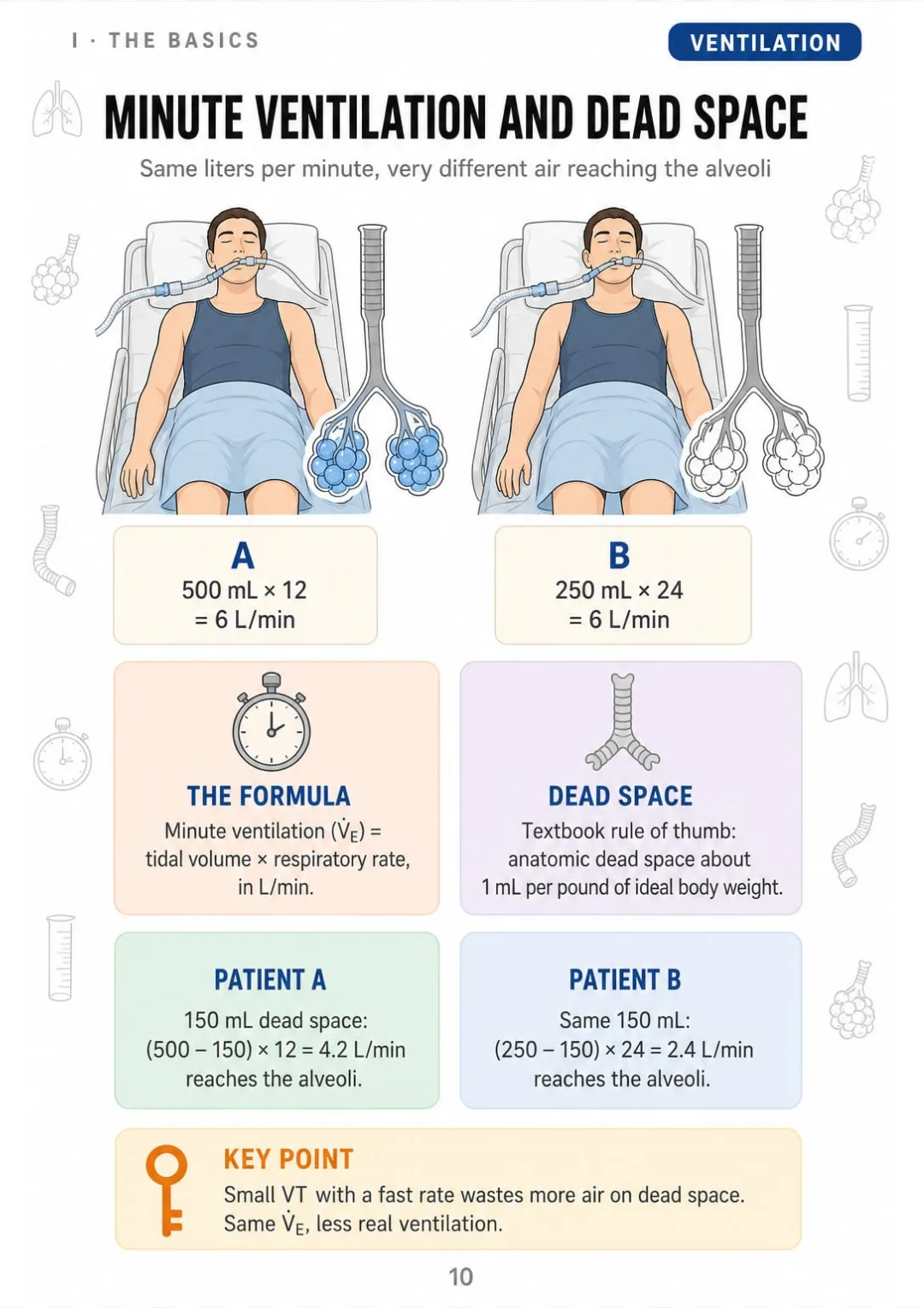
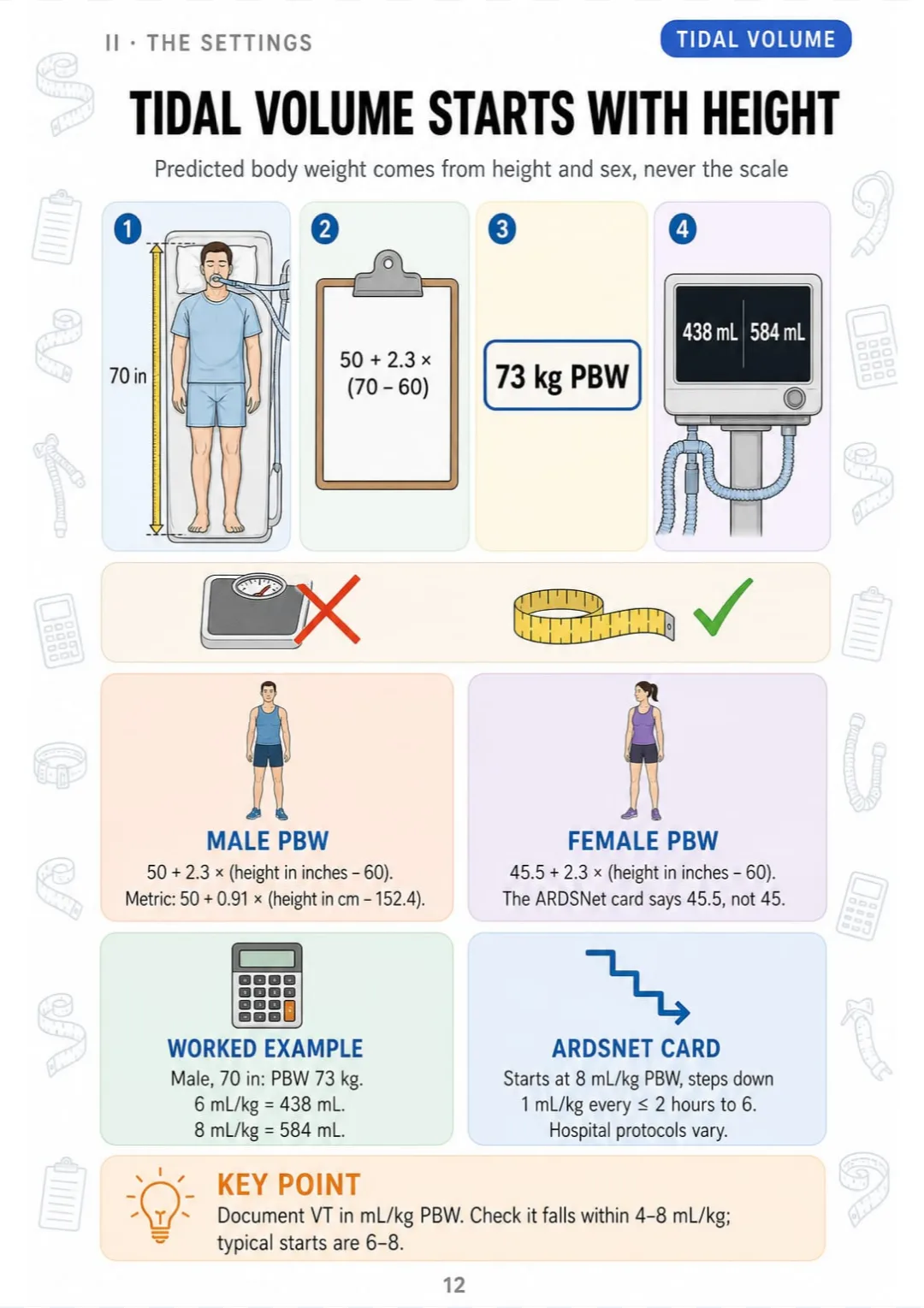
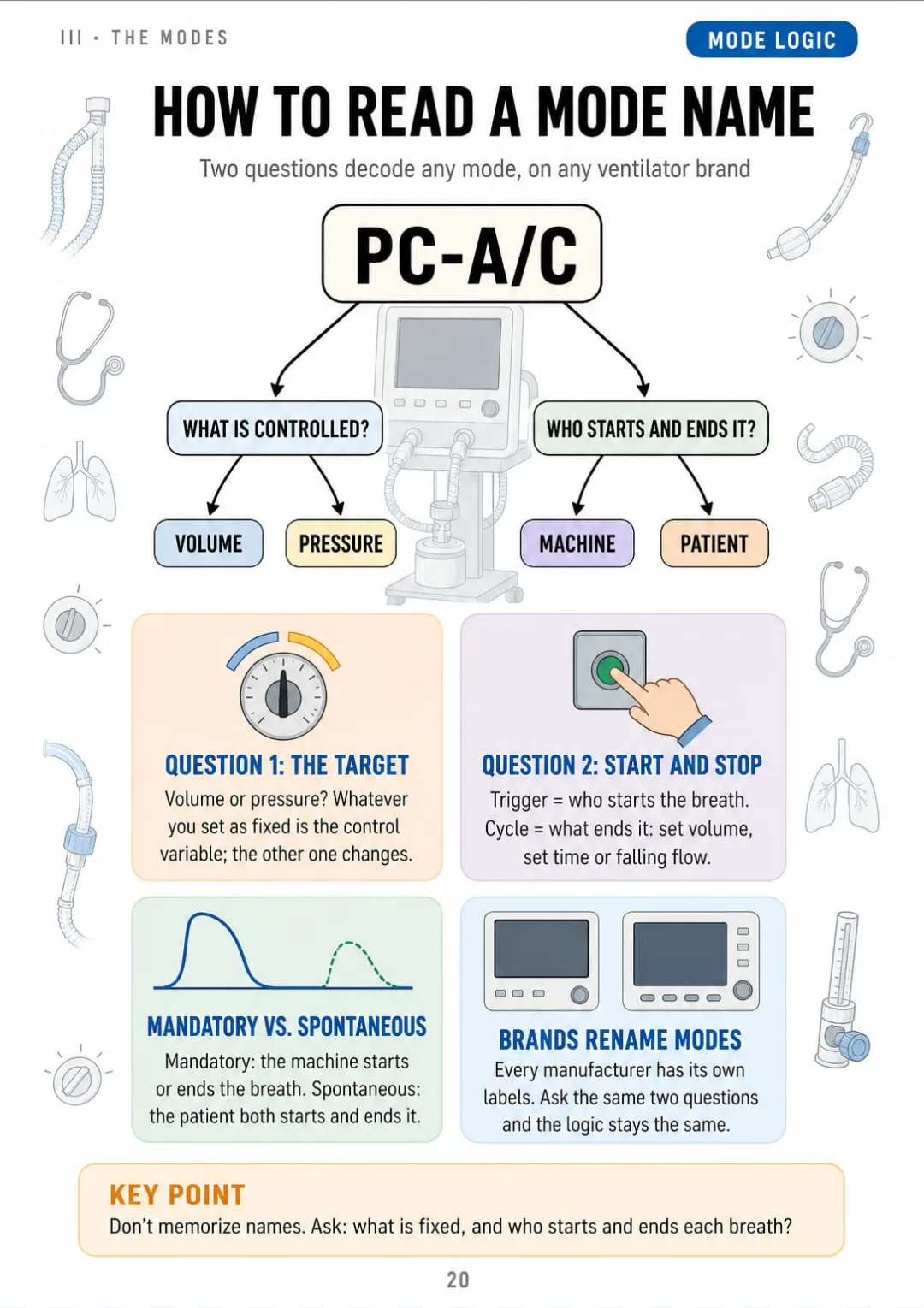
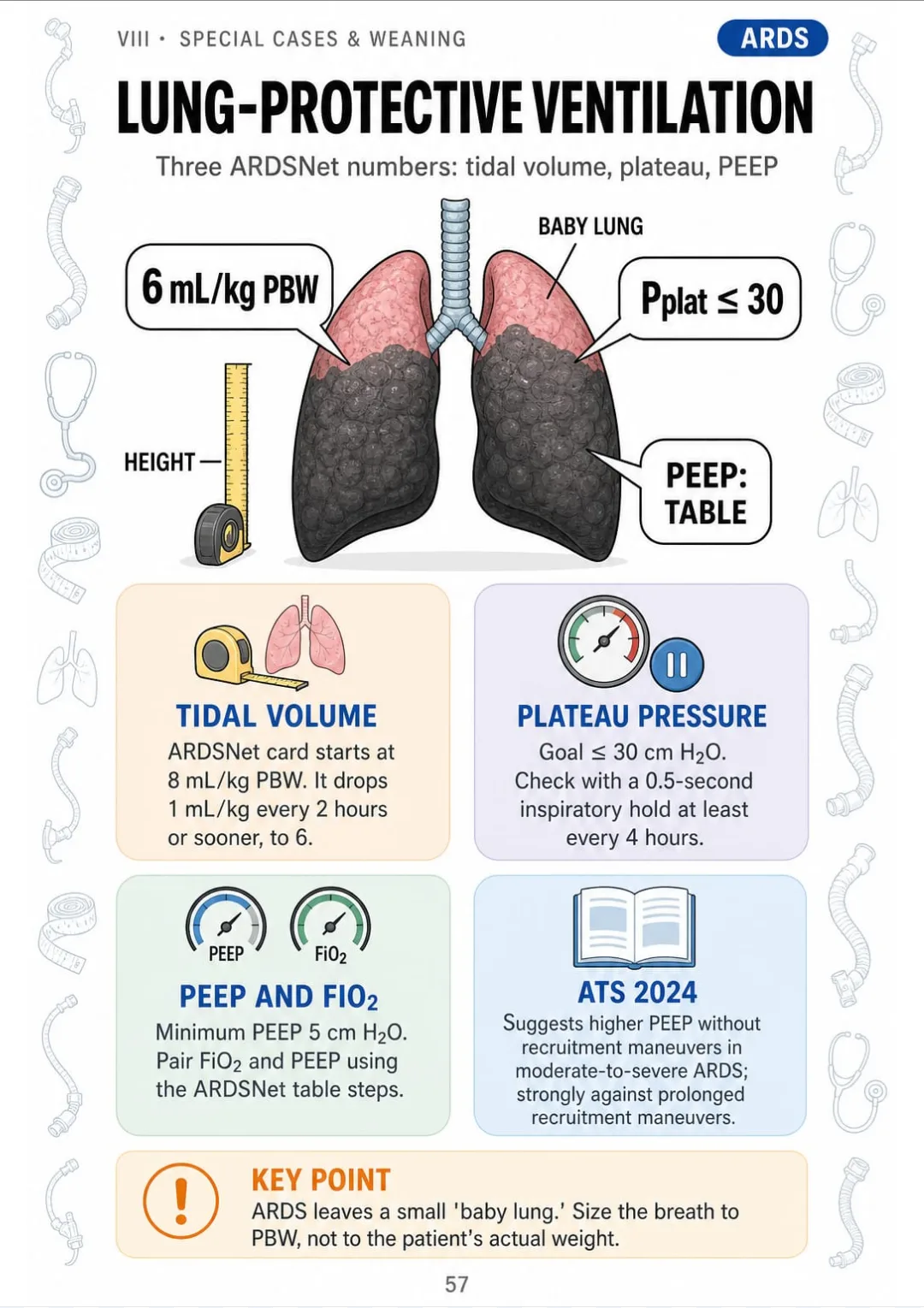
Every page has one big drawing and a box with the numbers and steps you need to know:


Swipe to see more →
These are real pages from the book. The table of contents is the full one: 9 parts and 64 topics.
You're standing at the vent and the screen says PC-SIMV with PS. The intensivist asks what the patient is actually getting.
Your manual gives every mode its own long section and its own acronyms. Nobody gave you one way to decode all of them, so A/C, SIMV and pressure support blur together by the next shift.

In the book, reading a mode name is one page: two questions, drawn. What's controlled, volume or pressure? And who starts and ends the breath, the patient or the vent? Every mode on the screen answers those two.
Tidal volume from height, the three curves on the screen, peak inspiratory pressure, the screen method and ABG normal values work the same way: each one has its own page.
You read the mode name, you know what the vent is doing, and you answer without going back to the manual.

The basics, the settings, the modes, waveforms, peak vs. plateau, alarms and the screen method, ABGs on the vent, special situations and weaning, and review and practice: 68 pages, all illustrated.
Think of it this way:
It's 3 a.m., your vented patient is coughing against the vent and the high-pressure alarm goes off. You need to know if the problem is the airway or the lungs.
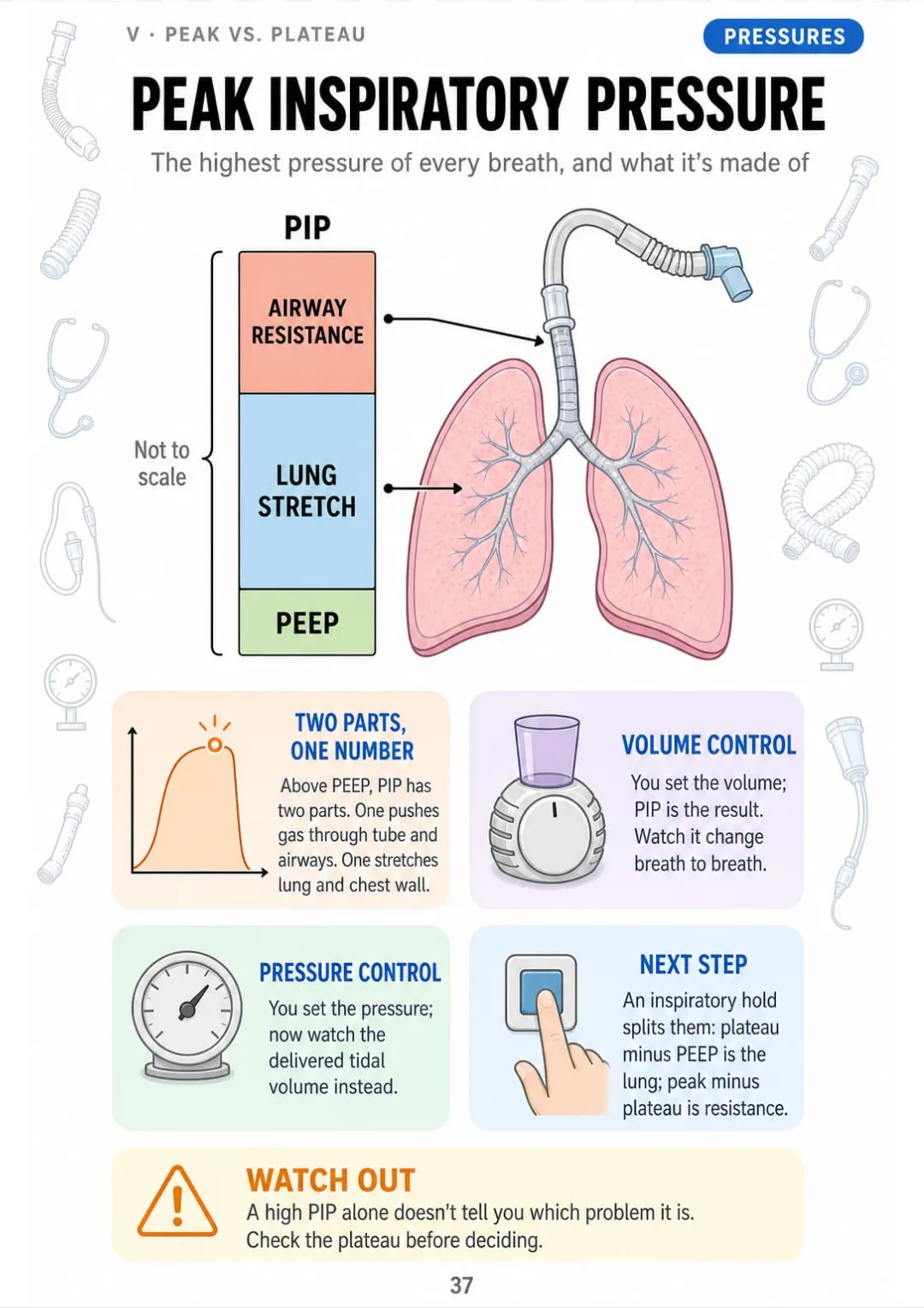
You open the page on peak inspiratory pressure and see one stacked column: PEEP at the bottom, lung stretch in the middle, airway resistance on top. Peak up, plateau the same: look at the airway.

Same with the mode name, tidal volume from height, the three curves on the screen, ABG normal values and the screen method: each one on its own page.
Mechanical Ventilation Illustrated is 9 parts and 64 topics, all drawn, and it ends with review pages: the one-page vent check, the shift handoff sheet, the most common mix-ups and every formula on one page.
What you see drawn, you don't have to memorize.
Why a patient ends up on the vent, negative vs. positive pressure, the circuit drawn end to end, the ET tube and cuff, compliance, resistance, minute ventilation and dead space.
Tidal volume from height, rate, FiO2, PEEP, I:E ratio, peak flow, trigger sensitivity and the initial settings card.
How to read a mode name, volume vs. pressure control, A/C, PC-A/C, SIMV, pressure support, CPAP, adaptive modes and APRV, and all four side by side.
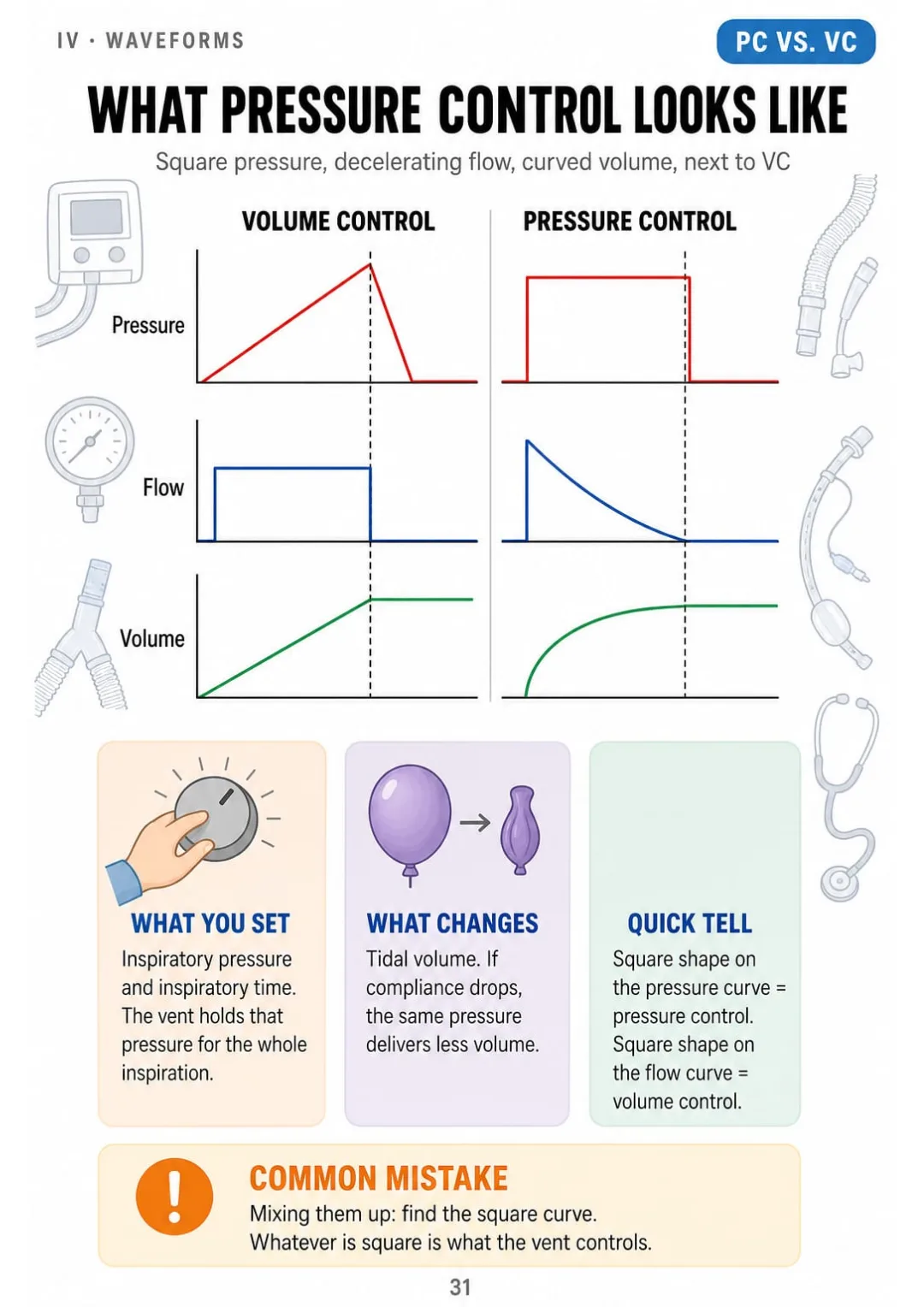
The three curves on the screen, volume and pressure control tracings, the trigger dip, auto-PEEP on the flow curve, asynchrony, leaks and loops.
Peak inspiratory pressure, plateau and the inspiratory hold, driving pressure, what it means when only peak rises or both rise, and auto-PEEP.
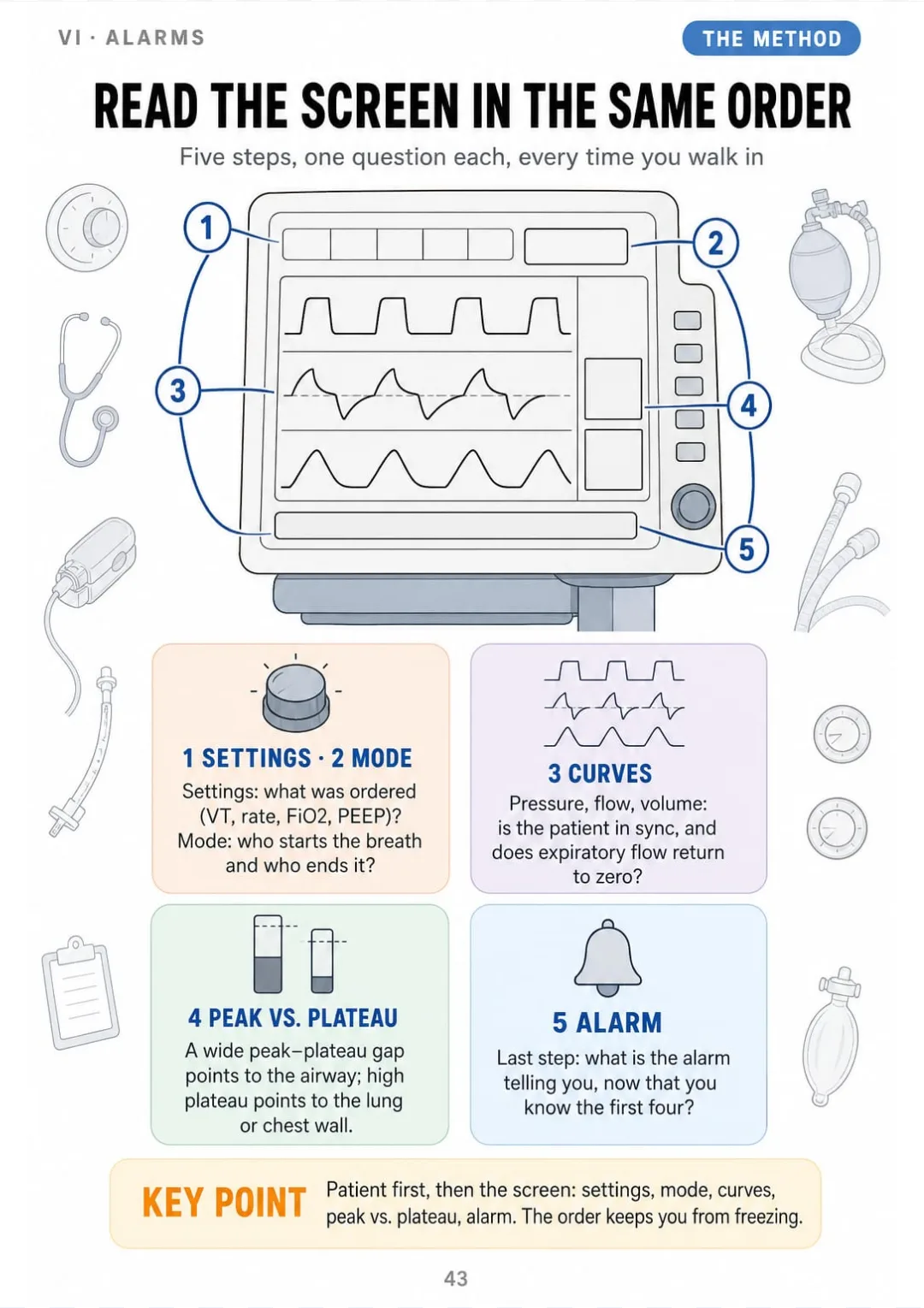
The screen read in the same order, patient first, high and low pressure alarms, low volume, high rate, apnea and DOPES.
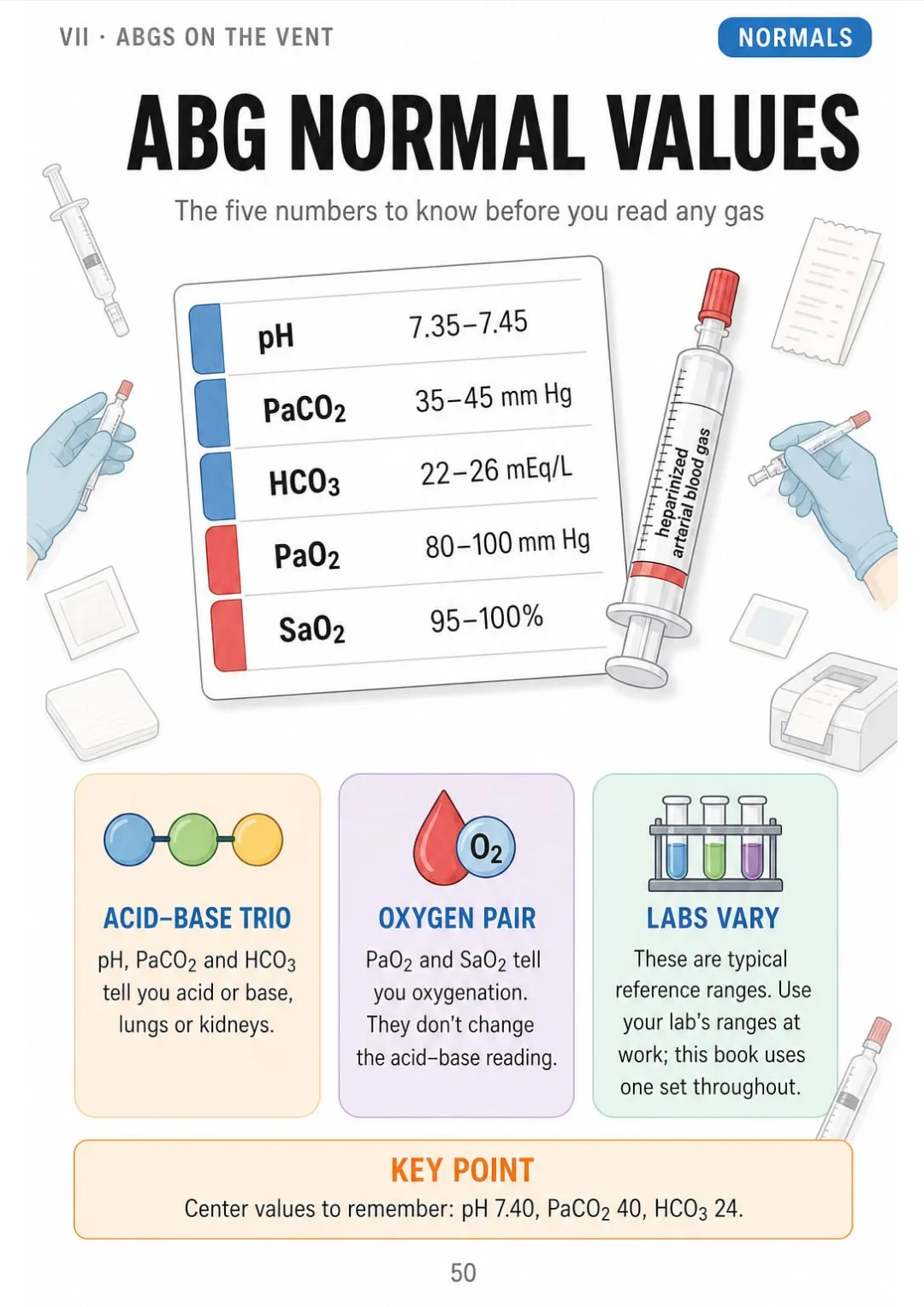
ABG normal values, the four-step read, which knob moves CO2, the P/F ratio, FiO2 and PEEP together and permissive hypercapnia.
Lung-protective ventilation, COPD and asthma, weaning criteria, the SBT, RSBI, the VAP bundle and transport ventilators.
The one-page vent check, the shift handoff sheet, the most common mix-ups, every formula on one page and the exam topic outline.
At the end of the book: A one-page vent check, a shift handoff sheet, the most common mix-ups and every formula on one page.
Board-style practice questions on settings, modes, waveforms and alarms, each with the answer and a short drawn explanation, so you check what you really know before exam day.

The mistakes that come up most often at the bedside and on practice exams (mixing up peak and plateau, confusing SIMV with pressure support, silencing an alarm before checking the patient), each on one page with the right way to think it through.
📄 This is a digital PDF book sent to your email: nothing is printed or shipped.
PDF by email: We email you Mechanical Ventilation Illustrated as a PDF, together with the two free books. It's a single payment: no installments, no extra charges.
Modes, curves and numbers stop blurring together: each one is a drawing on its own page, always read in the same order.
You review settings, waveforms, peak vs. plateau and ABGs at a glance, then check yourself with the exam-style questions.
You print the pages you need and read the screen in the same five steps before you call the RT or the doctor.
📄 This is a digital PDF book sent to your email: nothing is printed or shipped.
Try Mechanical Ventilation Illustrated for 30 days, bonus books included.
We refund everything if the file won't open, if the book isn't what you see here, if you were charged twice or if the email doesn't arrive. Just email us.
You pay once. No subscriptions.
Yes. It starts from why a patient needs the vent, but most of the book goes further: waveforms and asynchrony, peak vs. plateau and driving pressure, alarms, ABGs on the vent, ARDS, COPD and weaning. If you already did the coursework, jump straight to parts 4 to 8.
It's written for the US. Values and concepts are checked against the AARC Clinical Practice Guidelines and the NIH NHLBI ARDSNet protocol, the topic list follows the NBRC TMC Detailed Content Outline, and everything is in US units: inches, cm H2O and mm Hg.
No. It's an independent illustrated study guide, not affiliated with any exam board, association or ventilator manufacturer. It doesn't come with a certificate or CE credits.
No. It's study material only. It doesn't replace your training, clinical protocols, physician orders or device manuals, and it has no drug doses or settings for a specific patient.
No. The exam-style questions are written for this book. They're not official questions from any exam.
As a PDF by email, sent to the address you enter at checkout: the book and the 2 bonus books.
No. It's a one-time payment.
Yes. It's a printable PDF: print the whole book or just the pages you want to carry on shift.
You have 30 days. We refund everything if the file won't open, if the book isn't what you see on this page, if you were charged twice or if the email doesn't arrive: just email us.
No more rereading without anything sticking.
Peak vs. plateau: you see it drawn and that's it.
You walk into your shift or your exam knowing where everything is.
Drawings make studying faster.
The book is right below.
One-time payment: US$ 27 · Guarantee: 30 days · PDF by email
YES, I WANT MECHANICAL VENTILATION ILLUSTRATED FOR US$ 27📄 This is a digital PDF book sent to your email: nothing is printed or shipped.